I Play Rocky
- America was coming off the twin tragedies of the Viet Nam War and the Watergate political corruption scandal. Inflation was high, and American spirits were low. It was a difficult time. America needed a pick-me-up. And that’s exactly what young actor and screenwriter Sylvester Stallone provided with his smash hit motion picture “Rocky.”
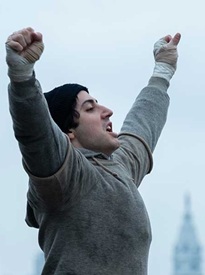 “Rocky”
Released at the end of 1976, “Rocky” told the tale of a down-on-his-luck prize fighter who works tirelessly to achieve his dream. He finally gets a shot at competing for the world heavyweight title. Since it didn’t star any big names (and did not feature an A list director), it took a while to catch on with audiences. Then in March of 1977, “Rocky” shocked the world by beating all three favorites (“Taxi Driver,” “Network,” and “All the President’s Men”) to win the coveted Best Picture Oscar. The movie which told the story of the proverbial “Little Engine That Could” had in fact become a Little Engine That Could itself. By the summer, “Rocky” was a huge hit at the box office. And Bill Conti’s instrumental theme song hit #1.
The Little Engine That Could
Now fifty years later comes another Little Engine That Could story. Written by Peter Gamble and directed by Peter Farrelly (“Green Book”), “I Play Rocky” tells the story of fledgling actor and writer Sylvester Stallone’s efforts to not only have his first-time screenplay developed into a major motion picture, but also to provide a starring vehicle for himself. The story of the making of “Rocky” is almost as inspiring as the original film. And when I say “almost,” I mean no matter how great “I Play Rocky” is (and it is a great film), it can never be as inspiring as the 1976 original.
The young star
Let’s start with the star, Anthony Ippolito. We all know Sylvester Stallone is an easy person to caricature. How many stand-up comedians and Saturday Night Live sketches have parodied Stallone’s quirky mannerisms? He’s like John Travolta in that he’s practically a walking caricature of himself. But Ippolito plays it straight. His take on Stallone – which is mildly annoying for about the first five minutes – is not simply an impersonation. Ippolito embodies the essence of Stallone. He becomes Stallone. So much so that when scenes from “Rocky” are interspersed throughout the closing credits, it’s hard to determine when we’re watching Ippolito and when we’re watching the real Stallone.
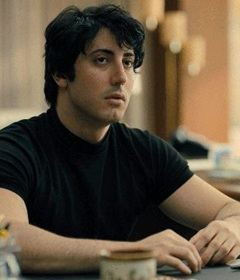 And how smart for Farrelly to use a relatively unknown actor to portray a superstar. Dexter Fletcher did the same thing in 2019 when he cast the unknown Taron Egerton to play music superstar Elton John in “Rocket Man.” In cases like this, the use of a more established actor would “muddy the water,” so to speak. We would always be conscious of the fact that we’re watching a well-known actor playing a well-known person. Problem solved by using Ippolito to play Stallone. He’s unknown. And he’s that good!
Two halves
As far as the story, both halves are interesting and inspiring, but I was more drawn to the first half, which traces Stallone’s life of living on the streets, working odd jobs, and struggling to write his first screenplay. The second half, which depicts the making of “Rocky” is also heartening and inspirational, but it features more recognized details, such as the use of the Steadicam to film the iconic scene of Rocky Balboa scaling the steps of the Philadelphia Museum of Art. Or the fact that neither Stallone nor actor Carl Weathers (who played fictional heavyweight champion Apollo Creed) could box a lick. It’s still interesting, but audiences will be more familiar with this material.
AnnaSophia Robb
Also worth noting is the performance of AnnaSophia Robb as Stallone’s first wife Sasha. She provides the inspiration Stallone needs to get his “Rocky” screenplay made into a movie, and to support his insistence that he play the lead. They say behind every great man is a great woman (and vice-versa, of course). In Stallone’s case, Sasha was that great woman. And the fact that Farrelly’s narrative concentrates so heavily on Sasha is a testament to her importance in telling this story.
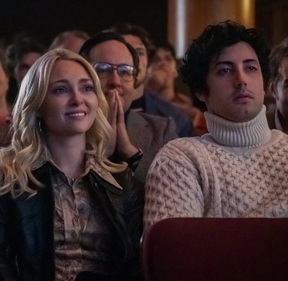 Years ago, Martin Scorsese impressed me with his inclusion of Lorraine Bracco’s character as protagonist Henry Hill’s wife in “GoodFellas.” He even included her voiceover narration as companion narration to that of Ray Liotta’s Hill character. She was that important to the film. Same with Felicity Jones’ character in James Marsh’s 2014 Stephen Hawking biography “The Theory of Everything.” As Hawking’s wife, she provided the conduit through which us mere mortals (i.e. the audience) was able to relate to the brilliant – and paralyzed – physicist. Robb’s character provides some of that same channel here. We relate more to the somewhat taciturn Stallone through the more expressive character of his wife.
Tracy Letts
“I Play Rocky” is chock full of top-notch supporting performances, but perhaps none more noteworthy than that of actor-playwright Tracy Letts, who plays fictional United Artists executive Sandy Maddox. Letts is always good – go re-watch “Lady Bird” or “Ford v Ferrari” – but here he brings it to another level with his comedic take on the studio naysayer who wants to nix every idea Stallone has, particularly his persistence that he play the Rocky Balboa character. Sandy wants to use Ryan O’Neal – a big box-office draw at the time, who had experience as an amateur boxer. Eventually, he sets the bar so high – such as not one day over schedule, or one dollar over budget – that he essentially sets up Stallone to fail. Per the contract, such a failure would trigger the use of a big-name star rather that Stallone.
Real obstacles
I typically don’t like films in which the screenplay places so many obstacles in the way of the success of the lead character – such as 2014’s “Birdman” – but in this case, these obstacles are real. This is a real story about the making of a real film. It’s hard to deny the impediments Stallone faced trying to get his career off the ground and score his first big hit. And in 2026, we find ourselves in another seemingly endless war, political corruption rages through the halls of Washington, and inflation is high – mirroring the malaise that was 1976. Thus, “I Play Rocky” mirrors “Rocky” – in terms of its inspirational heft and of its place in history.
Never as good as “Rocky”
With all its insipid sequels, it’s sometimes difficult to remember what a great film the first “Rocky” was. If “I Play Rocky” brings a whole new audience to Stallone’s 1976 classic, more power to director Peter Farrelly. But it’s somewhat like Steven Spielberg’s 2021 update of “West Side Story.” It was a great film. I had it on my Top Ten List that year. But it could never match the masterpiece that was the original. Same with Disney’s 2018 reboot “Mary Poppins Returns.” A very fine film. No match for the original. Farrelly is hampered here by the same principle. It’s not like he’s made a great film about the making of a B movie, a la Tim Burton’s “Ed Wood.” No, “I Play Rocky” is a great film – but it’s a great film about the making of an even better film. See “I Play Rocky.” And then do yourself a favor and re-watch “Rocky.”
Andy Ray‘s reviews also appear on https://townepost.com/tag/film-review/