La Bola Negra
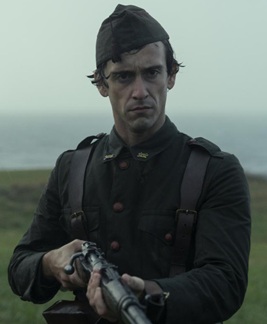 Federico Garcia Lorca was a Spanish poet and playwright who was killed during the Spanish Civil War. The popular thought is that he was killed by Nationalists for being a socialist. But others surmise his death was the result of his closeted homosexuality. When Garcia Lorca died, he left behind a well-respected book of poetry and three popular Spanish plays from the early 1930s, as well as an unfinished work some have surmised had a homosexual theme.
Best director at Cannes
Now, directors Javier Calvo and Javier Ambrossi have imagined what might have happened if Garcia Lorca had completed his homosexual drama before his untimely death. Their film “La Bola Negra” recently garnered them the Best Director prize at this year’s Cannes Film Festival. Skillfully hopping amongst settings from 1932, 1937, and 2017, “La Bola Negra” conceptualizes gay themes involving Garcia Lorca – renamed Carlos in the unfinished play, and played by Spanish actor Milo Quifes – the man who “found” the completed script and kept it for many years – named Sebastian, and played by Spanish singer-songwriter Guitarricadelafuente – and Alberto, the young openly gay writer who is gifted the work many decades later. He’s played by Spanish actor Carlos Gonzales.
1932 story
The 1932 segment features Carlos (Garcia Lorca’s fictionalized version of himself) trying in vain to earn membership into the local social club but facing rejection most likely due to rumors of his homosexuality. But many of the club members blackball his application, which gives this film its title, “The Black Ball,” or “La Bola Negra.”
 1937
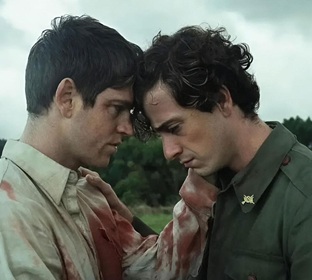
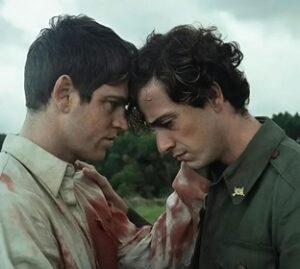
The 1937 portion (which accumulates the most screen time) involves Sebastian’s capture by Italian soldiers during the Spanish Civil War. They conscript him to fight with them during World War II – specifically to guard an injured soldier named Rafael Rodriguez Rapun (Spanish actor Miguel Bernardeau), who was the late Garcia Lorca’s lover. Sebastian’s assignment is to glean as much intelligence from Rafael before he is inevitably assassinated. Rafael introduces Sebastian to homosexual desire, but in the original screenplay’s greatest strength, their craving for one another remains unrequited.
2017
In 2017, Alberto – who is openly living in a gay relationship with his boyfriend in Madrid — when he is summoned to a town in Northern Spain by a lawyer who advises him of an inheritance by a grandfather he didn’t know.
The Javiers (Calbo and Ambrossi) introduce us to the major players (beginning with the 1937 narrative) quickly, then spend the remainder of the film bouncing among the three story lines. This is typically a confusing and unnecessary cinematic technique, and its use has indeed ruined several recent films. Here, the structure practically requires the constant chronological shifts, and the Javiers handle it skillfully, although their switcheroos occasionally come too fast.
 Too long
Also, they also could have cut a good 45 minutes from the middle portion of “La Bola Negra.” The screenplay drags, and includes an unnecessary insertion of Penelope Cruz as a popular cabaret singer who entertains the troops, takes Sebastian under her wing, and introduces him to the heavily closeted queer underbelly of 1930s Spanish society. I always enjoy Penelope Cruz, but her entire segment could have been eliminated.
Excellent denouement
By contrast, the Javiers nail the ending, drawing all three stories to their logical conclusions and tying up all loose ends, but not before throwing in just enough surprises to warrant a second viewing. Particularly impressive is Glenn Close as an American author and literary scholar who has been seeking Garcia Lorca’s incomplete work for most of her professional career.
The Javiers
If it sounds like “La Bola Negra” might be difficult to follow, it is not. Yes, there’s a lot going on here. There are a lot of characters, and a lot of interweaving narratives. But it is always very clear what’s happening and which story we’re watching. Even the lighting differs among each story. This is a masterful first directorial feature and original screenplay for Javier Calvo and Javier Ambrossi. Previously, these two have adapted an original stage play to the big screen, and have also directed a few short-lived Spanish television series. This is their first major work.
It’s no wonder they won Best Director at Cannes. And after watching their work, it’s also not a big stretch to see why “La Bola Negra” did not take home the Palme d’Or (Cannes’ version of the Best Picture Oscar). It’s an excellent film, and in a weak year might have scored the big prize, but the end result is not as strong as the effort that has been put into its creation. Again, another pass or two through the old editing mill would have helped, along with some longer sequences, which would have eliminated some of the too-quick narrative cuts.
Grand sweeping epic
“La Bola Negra” is certainly a major work of art. It is a grand, sweeping epic, along the lines of “The Odyssey.” At this point is probably the front runner for this year’s Best International Feature Oscar. I would have to say I enjoyed this one more than “The Odyssey,” and it may very well end up on my Top Ten List of the year’s best films. But it’s just not quite “tight” enough for me to say it’s the year’s very best. I was more drawn to the recent small little 90-minute feature called “The Only Living Pickpocket in New York,” in which John Turturro plays the last of a dying breed of petty thief. That one has stayed with me for weeks. Conversely, I may have trouble recalling the intricacies of “La Bola Negra” several years from now.
Andy Ray‘s reviews also appear on https://townepost.com/tag/film-review/