The Social Reckoning
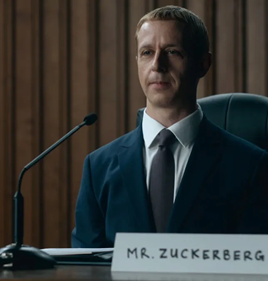 One of the top films of 2010 was David Fincher’s biographical drama “The Social Network,” which told the story of young Mark Zuckerberg and his founding of the worldwide phenomenon known as Facebook. Now 16 years later comes “The Social Reckoning,” again written by Aaron Sorkin, but this time directed by Sorkin as well. And it shows. Despite what you may have heard, this is the better film. It’s not a true sequel, as “The Social Reckoning” easily stands on its own as its own entity. It’s not necessary to have seen the earlier work.
More story this time
While “The Social Network” was an interesting and sometimes riveting account of Facebook’s formative years, the new project features more of a story – replete with good guys and bad guys. Zuckerberg was portrayed as somewhat the unwitting hero the first go ‘round; this time he is the antagonist. Played stern and cold by Jeremy Strong (who looks and sounds nothing like Jesse Eisenberg from the earlier film), this Zuckerberg prepares to take the stand for a U.S. Senate trial investigating Facebook’s role in swaying elections, non-existent fact checking of political advertising, and negatively impacting young users.
 Excellent Mikey Madison
The real star here is Facebook data engineer Frances Haugen, played by Mikey Madison, who won a Best Actress Oscar for her portrayal of a high-end call girl in Sean Baker’s hilarious “Anora” two years ago. She was excellent in that film. She’s even better here. Vulnerable yet determined to attract someone’s attention, Haugen is the whistleblower who discovers Facebook is feeding unwanted ads and content to its users based on previous posts, likes, and comments. Now, there’s certainly nothing wrong with the desire to turn a profit, but Haugen notices something amiss with her employer’s inflated role in the everyday existence of its users.
After running up against roadblocks from all her superiors at work, Haugen connects with Wall Street Journal reporter Jeff Horwitz, who happens to be investigating Facebook in San Francisco, where the company is headquartered. He doesn’t have enough evidence to publish anything yet, but Haugen helps him as best she can. As the two of them turn over additional evidence that Facebook users are becoming radicalized, “The Social Reckoning” really takes off. The art of discovery hasn’t been this exciting since “Spotlight.”
Jeremy Allen White
As Horwitz, Jeremy Allen White practically steals the show with his sad sack, technologically illiterate, old-school reporter character. It plays well against Madison’s Hauger, who is years younger but technologically brilliant, decisive, purposeful, and eternally optimistic. Again, she has an aura of vulnerability about her, but that only serves to accentuate her drive to expose the perceived wrongdoing of her employer – particularly when the two discover Facebook’s radicalization is intentional, as opposed to merely lax.
Bill Burr
Also strong in “The Social Reckoning” is comedian Bill Burr who plays Charlie, a confidant of Zuckerberg’s, who tries in vain to get Zuckerberg to realize his lenient content policy is responsible for amplifying hate speech and radical ideas amongst Facebook users. It’s odd to see a motion picture taking a stand against free speech, but in this case, Zuckerberg’s unfailing devotion to a free speech dogma is heavily responsible for causing the fanatical extremism inherent in American society.
 Overlapping story lines

One of Sorkin’s strengths is weaving together multiple stories which take place during different time periods – and keeping it all straight for the audience. Remember “The Trial of the Chicago 7” in 2020? There, he presented the story of the political and social protests at the 1968 Democratic convention in Chicago, interspersed with the 1969 courtroom trial in which the defendants were tasked with explaining and justifying their actions. The trial served as a narrative, if you will, of the primary action – that of the convention riots.
Here, he’s done the same thing. As Zuckerberg prepares to take the stand, his verbal justifications of Facebook’s lax oversight serve as the narrative to guide us through the prior story of researching and compiling the evidence against him and his empire. It’s a risky plot structure, as it can be confusing, but nobody does it better than Sorkin.
Among Sorkin’s best
So, where does “The Social Reckoning” rank amongst Sorkin’s directorial cinematic work? It is not as good as 2017’s “Molly’s Game,” in which Jessica Chastain played a former Olympic skier operating a high-stakes underground poker empire. The “rise and fall” story arc was something out of Martin Scorsese’s playbook, and Sorkin coupled it with his trademark fast, crisp, intelligent dialogue. I had that film at #4 on my Top Ten list that year.
“The Trial of the Chicago 7” was also strong, and I’d place “The Social Reckoning” right alongside that picture. Sorkin’s dialogue reminds me of the 1980s television series “Moonlighting” on steroids. I always enjoy watching his work a second time because I know I’ll see something I missed previously. That is definitely true here. The banter between Madison and White is dazzling, and the rapport between Burr and Strong’s stoic Zuckerberg character is humorous yet frustrating – as Zuckerberg continually fails to connect the proverbial dots between his lackadaisical free speech approach and the harm Facebook causes many of its regular users. “The Social Reckoning” takes its place among this year’s very best films.
Andy Ray‘s reviews also appear on https://townepost.com/tag/film-review/