The Odyssey
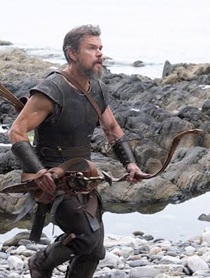 Coming just two years after his Oscar-winning “Oppenheimer,” director Christopher Nolan has seemingly bitten off more than he can chew with a grand-scale IMAX interpretation of Homer’s classic Greek epic “The Odyssey.” That Nolan succeeds with such a gamble is a testament to his talent – bring large epics to the big screen. But most of Nolan’s work was either based on original screenplays – like the “Dark Knight” trilogy – or based on recent history, such as “Oppenheimer.”
Dated source material
In “Oppenheimer,” it was important to get every detail exactly right. Here, the accuracy of the source material can be stretched a little, given its age. After all, how many of us can recall the fine details of anything we read in our college Ancient History class – particularly one written in the 7th or 8th century B.C.? Some historians have challenged a few of Nolan’s narrative choices. But does it really matter? Again, Nolan has succeeded in his apparent goal – making a riveting drama of a timeless tale.
About all most of us remember of “The Odyssey” is that its hero, Odysseus, spends the bulk of the story trying to return to his wife, son, and the throne of the Greek kingdom of Ithaca. Along the way, he meets several challenges, and it is unknown if (and how) he will ever accomplish his labyrinthine journey. And that’s really all we need to know here. Nolan fills in the holes – in our memories, and in what would otherwise be a thin outline for such a large-scale undertaking. In fact, Nolan’s screenplay is considered original – based on Homer’s epic poem, but not an adaptation, per se.
 Nolan’s version
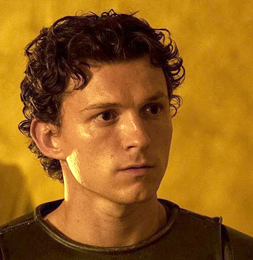
In Nolan’s “The Odyssey,” the versatile Matt Damon plays the Ithacan king, Anne Hathaway is his longing and loyal wife Penelope, and Tom Holland is their son and heir to the throne, Telemachus. Penelope’s time appears to be spent fending off suitors whose desire it is to claim the throne under the assumption that Odysseus must certainly have died, as the Trojan War is now twenty years in the past. Chief among her potential suitors is the sleazeball Antinous (Robert Pattinson), a man seemingly devoid of any virtuous character traits. But Penelope, Telemachus, and their half-blind servant Eumaeus – John Leguizamo, in the film’s best supporting performance — believe Odysseus is alive and will return. Furthermore, prematurely taking a suitor would deny Telemachus the throne she believes he deserves to inherit.
Odysseus’ journey
With this “present-day” set-up as the backdrop, Nolan then takes us on Odysseus’ journey, beginning with the masterful plan to break into the ancient city of Troy in a large wooden horse, presented to the Trojans as a gift from the Greeks. The resulting battle is classic Nolan, only to be outdone with the final scene depicting Odysseus’ return to Ithaca. Along the way, Odysseus and his ever-dwindling army of men meet up with various mythological creatures, including a giant cyclops sheep farmer who lives in a cave on a deserted island, and a tribe of man-eating giants on the island of Aeaea. These giants don suits of armor more closely resembling those of the Dark Ages rather than the 12th Century B.C. But then Odysseus and his men travel the seas in ships that look like 4th Century Viking ships rather than those of Ancient Greece.
The film’s strangest vignette finds the men stopping for food and supplies on an island inhabited by the mythological witch Circe, who feeds them but then turns them into pigs, in a creepy special effects sequence that borders on going overboard. Circe is played by Samantha Morton, who excels in this type of dark and tragic role.
Humanization of the gods
Even though much of “The Odyssey” features allegorical characters and situations, some viewers may have difficulty with the inclusion of Greek gods. The Greeks believed the gods live among us, and Homer’s epic is strewn with instances of its characters interacting with various gods. Although we never see Poseidon, God of the sea, he is referenced frequently, particularly pertaining to his revenge against Odysseus and his men by “rewarding” their various infractions with rough seas.
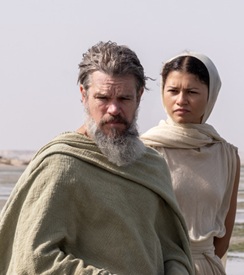 Oysseus has several conversations with Athena, the goddess of wisdom and warfare. She’s played by Zendaya, but never in any sort of spooky, moody cloud cover – which might indicate surreality. Instead, she’s presented as just another character. Similarly, Charlize Theron plays the nymph Calypso, who spends seven years comforting Odysseus and tending to his battle wounds, eventually promising him immortality if he chooses to spend eternity with her on the island of Ogygia rather than return to Ithaca.
Long, but never boring
There’s obviously a lot going on in this story, but Nolan doesn’t dwell on any one sequence long enough to induce boredom. And his occasional flash-forwards to Penelope and her suitors break the various story threads of the perils of Odysseus’ return. If Nolan’s greatest strength is his ability to master the epic motion picture, his second is his gift of storytelling, historical accuracy be damned.
Oscars coming?
Now, there has been some talk about “The Odyssey” finally earning Matt Damon the Best Actor Oscar which has so far escaped him – although he should have won for 2015’s “The Martian,” but that’s another story for another day. But let’s put Oscar talk to rest. First, “Oscar season” doesn’t truly kick into high gear until after Labor Day. And more importantly, epic films aren’t typically the types that result in accolades on the actors. The actors’ performances are seen as “in service” to the screenplay. And that’s exactly the case here.
Damon is fine as Odysseus, but the character doesn’t grow or evolve as the film progresses. Yes, he wrestles with his status as all-powerful heavy-handed king versus a kind and understanding mentor to his men. But he doesn’t show the range he’s shown in many other films. I know Charlton Heston won for “Ben-Hur,” but that’s more the exception to the rule. After all, Peter O’Toole did not win Best Actor for “Lawrence of Arabia,” yet that sweeping epic did win Best Picture. Likewise, Kirk Douglas did not win for “Spartacus.” Nor did Paul Newman for “Exodus.”
Modern-day grand epic
Nolan’s “The Odyssey” is the modern-day version of “Ben-Hur,” “Spartacus,” and “Lawrence of Arabia.” People will still be talking about this one years from now. Is it any better or worse than any of the sweeping epics that have come before it? That’s hard to say. While “Ben-Hur” looks dated now, its special effects were considered legendary in 1959. 67 years from now “The Odyssey” will undoubtedly appear dated too. But my guess is it will still be seen as a classic.
Andy Ray‘s reviews also appear on https://townepost.com/tag/film-review/