Dead Man’s Wire
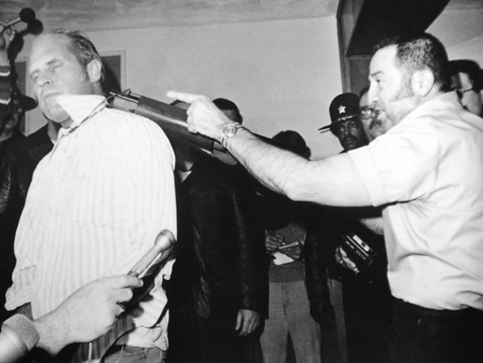 On a cold February morning in 1977, land developer Tony Kiritsis walked into the offices of Meridian Mortgage in Indianapolis and promptly wired a loaded shotgun around the neck of company president Richard Hall. Kiritsis was upset that he had purchased a tract of land to develop on the west side, but Meridian had subsequently sold the land to someone else. Determined to “get even” with a business he viewed as evil, Kiritsis proceeded to take the law into his own hands.
Local news story
The Kiritsis saga is the subject of veteran director Gus Van Sant’s latest effort, “Dead Man’s Wire,” so named because the shotgun was rigged to fire if anyone attacked Kiritsis – akin to the hostage taker who stands ever so close to the victim, lest the authorities attempt to shoot the criminal from afar. “Dead Man’s Wire” would seem a logical choice for a Van Sant project, as his career has often featured stories of those on the fringes of society, who simply can’t seem to play by its rules. His early works “Drugstore Cowboy” and “My Own Private Idaho” follow this theme, as does his most recent picture “Don’t Worry, He Won’t Get Far on Foot.” That was the story of the paraplegic alcoholic who made career, such as it was, of drawing tasteless newspaper cartoons. Joachin Phoenix was excellent as the societal outcast in that picture; Bill Skarsgard is likewise strong here.
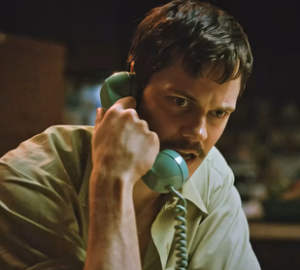 Perfectly captures character
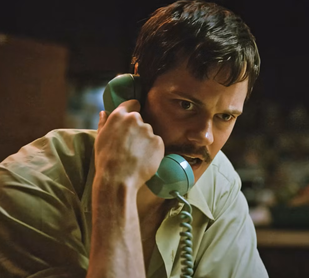
As Kiritsis, Skarsgard captures the pent-up anger, jealousy, and (dare I say) showmanship of a man who appears to be on the verge of snapping at any moment. His personality waffles somewhere between logical sanity and absolute madness. Skarsgard handles the role about as well as anyone (save for perhaps Phoenix), as he merges his delusion with a certain degree of fearlessness that endures him to a large segment of the American population. Skarsgard doesn’t look anything like Kiritsis, but he fully embodies his disposition. Dacre Montgomery, on the other hand, is a dead ringer for Richard Hall.
National hero
Originally a breaking local news story, the Kiritsis kidnapping played out over three days, capturing the attention of the national news media. Kiritsis had a beef with a company he believed had treated him unfairly and was dead-set on exposing his mistreatment to the entire world – at least to anyone who would listen. He came to be seen as the proverbial little man wronged by the big, bad machine of corporate America. For a couple traumatic days, he became somewhat of a national hero. People knew he was breaking the law. Many saw him as insane. But people seemed to connect with his plight. He had his audience right where he wanted it.
And this is where “Dead Man’s Wire” manages to succeed. In this respect, Van Sant’s film (from an original screenplay by Austin Kolodney) mines the same territory as a couple Sidney Lumet films from the 1970s. “Network” comes immediately to mind, what with the disgruntled network newscaster encouraging discontented Americans to open their windows and scream, “I’m not going to take it anymore!” The almost real-time progression of “Dead Man’s Wire” makes it practically a companion piece to Lumet’s “Dog Day Afternoon.” Cementing that connection is the fact that Al Pacino (star of “Dog Day”) has a cameo in Van Sant’s film.
Slight misfire
I do think “Dead Man’s Wire” misfires in a couple respects, however. I don’t mind that filmmakers change characters in real life stories. After all, they’re making art, not reporting a story. However, after Kiritsis paraded Hall through the snowy Indianapolis streets, commandeered a police car, and drove his victim to his bobby-trapped westside apartment, he commenced a dialog with WIBC news director Fred Heckman, who was at the time arguably the most respected voice in Indianapolis news. Kiritsis demanded airtime to express his grievance, and Heckman obliged – all while attempting to talk him out of killing his victim, a skill in which Heckman had no formal training.
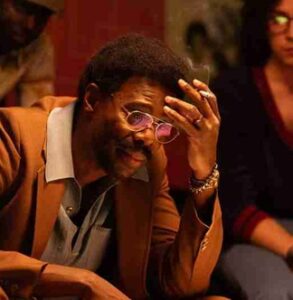 Character replaced
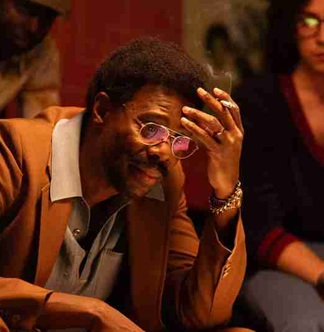
In “Dead Man’s Wire,” Fred Heckman is replaced by a fictitious smooth jazz DJ by the name of Fred Temple. Played by Colman Domingo, Temple is obviously someone Kiritsis trusts, and Kiritsis uses Temple to air his grievance. But I wonder why this change was made. First, it makes more sense for Kiritsis to want to use the voice of the most respected (and most listened to) newscaster in Central Indiana to expose his anger. Much as I love smooth jazz, that person would not be a smooth jazz DJ! And second, it feels as though Van Sant and Kolodney use the Fred Temple character to assure us that Kiritsis is not racist. Why racism would play into this story at all is beyond me, but that seems to be the impetus behind changing the radio character.
Local news reporter
Consider too that actress Myha’la plays fictional local news reporter Linda Page, consigned to covering what she refers to as “powder puff” human interest stories rather than the preferred hard news. Page and her cameraman just so happen to be stopped at a red light when they see Kiritsis and Hall emerge from the office building which houses Meridian Mortgage. She follows the commandeered police car to the westside apartment complex and continues to provide live updates as the story progresses.
Now, why has this character inserted into the Kiritsis story? To flesh out the material and make a feature length motion picture? Perhaps. But given the time setting, her inclusion reminds us that in the 1970s, black news reporters (particularly black females) were not given the hard-hitting stories of the day. It’s as though they weren’t fully trusted to bring us the “serious” news. The Linda Page character reveals how difficult it was to break that barrier. Kudos to Van Sant and Kolodney.
Racism angle
But (and this is a big “but”) the incorporation of the Linda Page character and the Fred Temple character would appear to coexist to prove Kiritsis’ acceptance of African Americans. Page shows us how far black people had to go in the ‘70s, and his connection with Temple shows us that Kiritsis fully accepted them. Again, I have lived in Indianapolis my entire life and have never heard the slightest inkling of anyone accusing Tony Kiritsis of being a racist. But then, why are these two fictional characters a part of this narrative at all? It causes me to wonder.
 Critic’s disclaimer
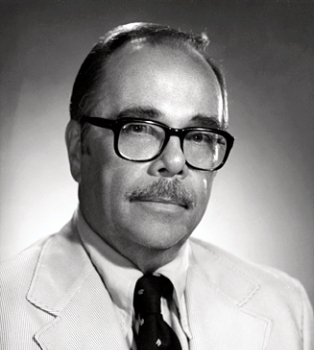
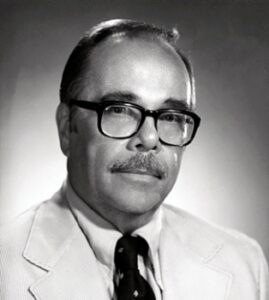
And now for a disclaimer I feel I must share because I’m from Indianapolis, and I remember when this episode played out. I almost didn’t review “Dead Man’s Wire” because I knew Fred Heckman. He was a personal acquaintance, and he was responsible for getting me my internship with WIBC in 1984. I went to school with his son. My parents went to church with his wife. I almost feel too connected to the story to objectively review it. Because of this connection, my disgruntlement with replacing Heckman with the Fred Temple character may be stronger than it would be without that connection. Unfortunately, I will never know. I probably dislike the character swap more than most, because of my connection with the Heckman family.
Continuity errors
On a lighter note, I realize there are continuity errors in every film ever made. However, being an Indianapolis native, I must express my surprise when Van Sant’s camera (following Kiritsis and Hall in the hijacked police car through the streets of Indianapolis) shows a red Hoosier Lottery sign in the background. Indiana did not have a lottery until 1989.
Also, I was impressed with the inclusion of actual local news footage from 1977, featuring Clyde Lee from Channel 6, and Paul Udell and Dennis McCabe from Channel 13. But I wonder why the filmmakers used Channel 12 as the fictional station for the fictional news reporter Linda Page. The “Channel 13” logo is very present on Udell’s microphones throughout the film. No city would have both a Channel 13 and a Channel 12. Back then, there would have been too great a chance of “bleed over” from one channel to the other. Why didn’t Kolodney use Channel 11 or Channel 10 for his fictional news station – particularly when “Channel 13” is so present on the microphones of his archival footage?
Worth a view
But I fear I complain too much. Again, these are considered continuity errors, and every film contains them. The bottom line is that “Dead Man’s Wire” is a taught thriller – whether it is based on a real story or not. And high praise to Skarsgard for perfectly pulling off this complex character. Again, he might initially come across as “wacko,” but he has the ability to make us think. He’s the proverbial little man beaten down by corporate America. In that respect, “Deal Man’s Wire” is well worth a view.
Andy Ray‘s reviews also appear on https://townepost.com/tag/film-reviews/