Project Hail Mary
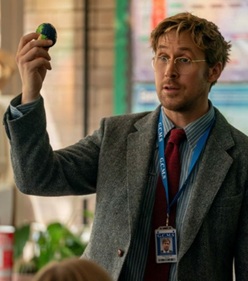 Dr. Ryland Grace is a molecular biologist who published a theory since disproven by the wider scientific community. In his retreat from public life, he now teaches middle school science. One day, Dr. Grace is apprehended – and by apprehended, I mean taken away in broad daylight – by NASA scientists who require his knowledge. You see, the sun is rapidly shrinking due to a microorganism called Astrophage which is expeditiously multiplying on the sun’s surface.
In fact, Astrophage is expeditiously multiplying on the surfaces of every star in the Milky Way galaxy save for one – Tau Ceti, located in the Cetus constellation. NASA is sending a crew of three – two astronauts and Dr. Grace – on a suicide mission to Tau Ceti to probe the star’s surface and return the probes to earth for study.
The premise
This is the premise for Phil Lord and Christopher Miller’s new film “Project Hail Mary,” starring Ryan Gosling as Dr. Grace. Drew Goddard’s screenplay is adapted from Andy Weir’s novel of the same name. Weir also wrote “The Martian,” which lent itself to Ridley Scott’s excellent 2015 film. This one takes its cue somewhat from “The Andromeda Strain,” but aims in a more mainstream direction – as we might expect from Lord & Miller, who have brought us “The Lego Movie” and “21 Jump Street.”
As “Project Hail Mary” opens, Dr. Grace awakens from a coma, to discover he is the only living crew member. As he begins to recollect his memories, Goddard’s screenplay jumps back to his time on earth, when he was “assigned” this task by NASA. Each time Grace recalls a significant factoid, we return to that pre-mission moment.
 Rocky
Rocky
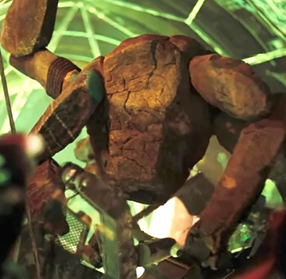
In the present, Grace’s spacecraft docks with one from the 40 Endrani star system, where he meets a crab-like creature he names Rocky – since he looks like a small collection of rocks. Grace uses a machine translation system to convert Rocky’s various intonations into English, so he (and by extension, we) can understand him. They teach each other various forms of communication native to their own species. Rocky’s constant difficulty with a simple “thumbs up” is one of the film’s funniest running gags. I do wonder, however, why Rocky speaks in broken English, often omitting verbs and connecting words. Does he have to sound like Tonto for us to understand that English is not his native language?
The inclusion of Rocky seems at first to be an excuse for us to hear Dr. Grace’s thoughts – to give him someone to talk to, so we know what he’s thinking. Ironically, Sandra Bullock didn’t need a sounding board in “Gravity.” But perhaps I nitpick. We eventually come to appreciate Rocky’s incorporation into the story because he comes from a society more advanced than our own. We think of Dr. Grace as very intelligent; Rocky exceeds him. This propels the narrative to greater scientific heights.
The use of science
And the screenplay’s reliance on science as the impetus behind its plot is one of its strengths. Much as in “The Martian” – or “Gravity” or “Interstellar” – the science behind the set-up draws us into the proceedings in a way that, say, a madman who wants to blow up the world would not. This is not a film for teenage boys. Not saying some of them won’t enjoy it, but so will Mom and Dad.
For the record, Tau Ceti is a real star. 40 Eridani is a system of three stars. Astrophage is not a real microorganism. But the point is, the scientific setup is believable.
Mainstream directors
This is a step in the right direction for Lord & Miller, who have (so far) made a career of directing mainstream fare. They do fall back on certain traps, however. Daniel Pemberton’s overpowering score serves as a detriment to the overall arc of the story. Just once, I would like to have made a personal reaction to a plot development in “Project Hail Mary” without having the orchestral music tell me how I’m supposed to feel. “Gravity” featured much less music and was a superior film because it allowed me to form feelings all by myself. Lord & Miller also unnecessarily insert little asides to “Close Encounters of the Third Kind,” and “2001: A Space Odyssey.” These digressions are somewhat cute, but they also remind us of far better films.
 Ryan Gosling
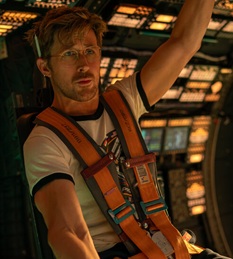
Fortunately, “Project Hail Mary” is saved by Ryan Gosling’s best performance since “La La Land.” Gosling’s understated persona encompasses that puppy-dog face earnestness we used to see in the early independent film portion of Nicholas Cage’s career. Gosling is one of the few actors who can tear up during a particularly heartfelt communication with Rocky and it doesn’t come off as maudlin. We feel Gosling’s emotion, and that’s what this film needs to succeed on all levels.
Good flashbacks!
Now, this may be the only time I have ever written this phrase, but “Project Hail Mary” is also saved by its reliance on flashbacks. Usually a hindrance to plot flow, here the backstory of NASA’s “recruitment” of Dr. Grace, their development and execution of the Tau Ceti mission, and Dr. Grace’s initial reluctance to participate is more interesting than the “present day” narrative of the interplay between Grace and Rocky. Had the story been presented lineally, we would quickly lose interest once Grace awakens to find he is alone in space with a lifeform from another part of the universe. These sequences tend to drag, as there is not much forward direction to the plot until the two arrive at Tau Ceti.
Step in the right direction
To say “Project Hail Mary” is a mixed bag would be a little harsh. It doesn’t rise to the level of some other recent sci-fi films, but at least it doesn’t get bogged down in its own weight, a la “Interstellar.” Nor does it come off as lightweight kiddie fare. Lord and Miller have threaded the needle pretty accurately between their early mainstream films and what I hope will lead to deeper, more intricate work going forward.
Andy Ray‘s reviews also appear on https://townepost.com/tag/film-review/