Wuthering Heights
With its themes of unrequited love, accumulation of vast wealth, and revenge, English author Emily Bronte’s 1847 novel “Wuthering Heights” would seem to lend itself well to Hollywood interpretations. And indeed it has. Not counting foreign films or television adaptations, no fewer than a half-dozen versions have been produced, dating back as far as a 1920 silent film.
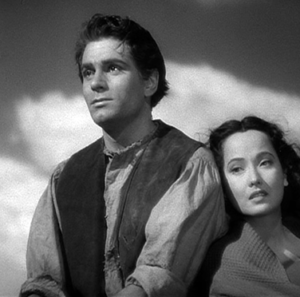 1939 version
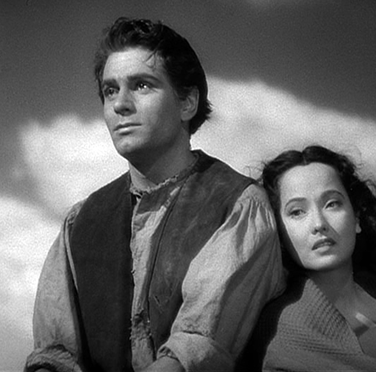
The standard by which all translations shall be judged is William Wyler’s 1939 classic, starring Laurence Olivier, Merle Oberon, and a young David Niven. Unfortunately, considering its release during “Hollywood’s Greatest Year,” it was lost in the shuffle of “Gone with the Wind,” “The Wizard of Oz,” “Ninotchka,” and “Mr. Smith Goes to Washington.” Consequently, the Wyler version often doesn’t receive the merit it deserves.
Ripe for a remake
Given that the source material has a concentration on a turbulent extramarital affair between two childhood friends, “Wuthering Heights” would seem ripe for a modern-day revision in which the sex is front and center. If handled with respect and decency, “Wuthering Heights” could find new life amongst today’s audiences. And that’s exactly what filmmaker Emerald Fennell has done, amidst pre-publicity that her concentration on the story’s carnal aspects detracts from the power of the story.
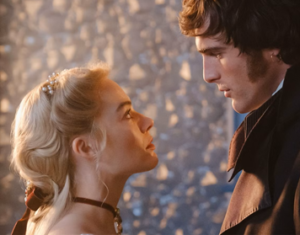 The two leads
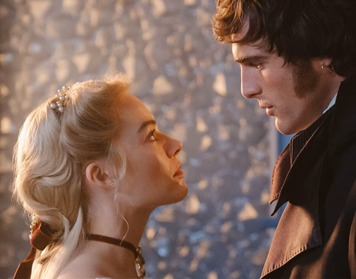
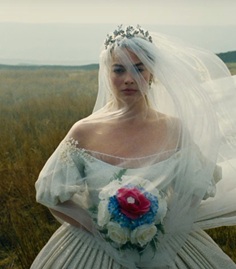
Margot Robbie – who seems to be everywhere these days – plays Catherine Earnshaw, raised by her alcoholic, gambling-addict father (British actor Martin Clunes). The family servant closest to Catherine is Nelly, played by Hong Chau – so great in “Driveways” and “The Whale.” One day, Mr. Earnshaw “rescues” an illiterate orphan boy from the streets of Liverpool and brings him home to the estate to serve as Catherine’s “pet.” She names him Heathcliff, after her deceased brother. He’s played by Jacob Elordi, who starred as Elvis Presley in Sofia Coppola’s “Priscilla.” As they are about the same age, Catherine and Heathcliff begin spending their days together. They play with one another of course, but Catherine also teaches Heathcliff to read.
Australian native Robbie is perfect for the part of Catherine. Smug and just a touch self-righteous, Robbie softens what could be an unlikeable character into a charismatic heroine who usually leads with her heart. Even though we know she covets wealth and privilege, we can’t help but root for her best interests. American actor Elordi is weaker with the British accent, and he never seems to fully embrace the source material the way Robbie does. He never completely immerses himself in the adventure. Yet he has that magnetic attraction with the camera that simply can’t be taught. Some actors have it – think Paul Newman or Brad Pitt – while others do not.
 Catherine’s marriage
As Mr. Earnshaw begins to fritter away his fortune with his incessant gambling, the Linton family moves into the estate next door. (And five miles away counts as “next door” here.) While visiting the Lintons, Catherine sprains her ankle, requiring the constant attention available at the Linton estate but not at the Earnshaws. During her recovery period, Catherine falls in love with young Edgar Linton (Shazad Latif), who proposes marriage. Seeing their union as a means to escape her father’s rapidly approaching poverty and join the high society she so craves, Catherine accepts the proposal, much to the chagrin of Heathcliff.
The heartbroken Heathcliff leaves Liverpool, only to return five years later to begin a torrid love affair with Catherine, the only woman he has ever loved. Likewise, we are led to believe Heathcliff is the only man Catherine has ever loved. And this is where Fennell’s adapted screenplay goes awry.
Obsession with sex
If I may address Fennell’s obsession with the story’s sensual angle, the sex doesn’t come off as out-of-place, as it did in Ridley Scott’s “Napoleon.” After all, Catherine’s and Heathcliff’s affair is the meat of the narrative. Where Fennell misfires is in her long sequence showing us an endless string of trysts set to a Charli XCX song – which in itself is out-of-place in any adaptation of “Wuthering Heights.” Catherine’s and Heathcliff’s rendezvous need to be so forbidden as to be infrequent and clandestine. By devoting what feels like half a reel of film to their sordid affair, she boxes herself into a corner. In other words, once their love has been codified, there’s simply nowhere else for the story to go. If it had remained somewhat forbidden, we would continue to root for the star-crossed lovers all the way through to the film’s ending.
Lack of emotional intensity
Consequently, the final denouement (during which Heathcliffe looks back on his life with Catherine) fails to provoke the emotional intensity Fennell is aiming for. And don’t for a minute blame it on the fact this is a period piece. Just a couple months ago, Chloe Zhao struck an emotional killer of an ending with her brilliant “Hamnet.” The finale of Clint Bentley’s recent “Train Dreams” features one of the greatest half-hours of filmmaking in recent years, as the hero reflects on his life’s journey. “Wuthering Heights” simply fails to rise to that level of emotional brilliance.
Fennell’s masterpiece (so far) is her 2020 thriller “Promising Young Woman” starring Carey Mulligan. That film earned Fennell a well-deserved Oscar for Best Original Screenplay. Her ultra-weird 2023 offering “Saltburn” (also starring Elordi) was a letdown. “Wuthering Heights” falls somewhere in the middle. Unfortunately, the best compliment I can pay “Wuthering Heights” is to say it’s not as bad as you’ve heard. But I realize that is faint praise, at best.
Andy Ray‘s reviews also appear on https://townepost.com/tag/film-reviews/